El juego completo
Veamos un ejemplo completo. No hace falta entenderlo todo. Iremos viendo luego cada parte.
El ejemplo viene de aquí
Pasos en el análisis causal.
- Definir la pregunta causal
- Especificar las asunciones, una forma es con un diagrama causal
- Modelar las asunciones
- Diagnosticar el modelo
- Estimar el efecto causal
- Análisis de sensibilidad
Datos
id-
ID
-
netynet_num -
Indican si se usa mosquitera (1) o no (0)
malaria_risk-
Riesgo de malaria 0-100
income-
ingresos, medida en dólares
health-
Puntuación en salud de 0–100
household-
Número de personas en el hogar
eligible-
Indica si el hogar es eligible para programa de mosquitera gratis.
temperature-
La temperatura media por las noches, en Celsius
resistance-
Resistencia de los mosquitos locales al insecticida. Escala de 0–100, valores altos indican mayor resistencia
| Name | select(net_data, (-id)) |
| Number of rows | 1752 |
| Number of columns | 9 |
| _______________________ | |
| Column type frequency: | |
| logical | 2 |
| numeric | 7 |
| ________________________ | |
| Group variables | None |
Variable type: logical
| skim_variable | n_missing | complete_rate | mean | count |
|---|---|---|---|---|
| net | 0 | 1 | 0.26 | FAL: 1298, TRU: 454 |
| eligible | 0 | 1 | 0.02 | FAL: 1716, TRU: 36 |
Variable type: numeric
| skim_variable | n_missing | complete_rate | mean | sd | p0 | p25 | p50 | p75 | p100 | hist |
|---|---|---|---|---|---|---|---|---|---|---|
| net_num | 0 | 1 | 0.26 | 0.44 | 0.0 | 0.0 | 0.0 | 1.0 | 1.0 | ▇▁▁▁▃ |
| malaria_risk | 0 | 1 | 39.67 | 15.37 | 10.0 | 28.0 | 36.0 | 50.0 | 90.0 | ▃▇▅▂▁ |
| income | 0 | 1 | 897.76 | 191.24 | 330.0 | 764.8 | 893.0 | 1031.0 | 1484.0 | ▁▅▇▅▁ |
| health | 0 | 1 | 50.21 | 19.35 | 5.0 | 37.0 | 50.0 | 64.0 | 100.0 | ▂▆▇▅▁ |
| household | 0 | 1 | 2.97 | 1.41 | 1.0 | 2.0 | 3.0 | 4.0 | 9.0 | ▇▇▂▁▁ |
| temperature | 0 | 1 | 23.93 | 4.10 | 15.6 | 20.9 | 23.8 | 27.1 | 32.2 | ▃▇▇▇▃ |
| insecticide_resistance | 0 | 1 | 50.08 | 14.44 | 5.0 | 40.0 | 50.0 | 60.0 | 95.0 | ▁▅▇▃▁ |
Show the code
DT::datatable(net_data)Esp## Especificar cuestión causal
- ¿El uso de la mosquitera reduce el riesgo de malaria?
Show the code
net_data |>
  ggplot(aes(malaria_risk, fill = net)) +
  geom_density(color = NA, alpha = .8)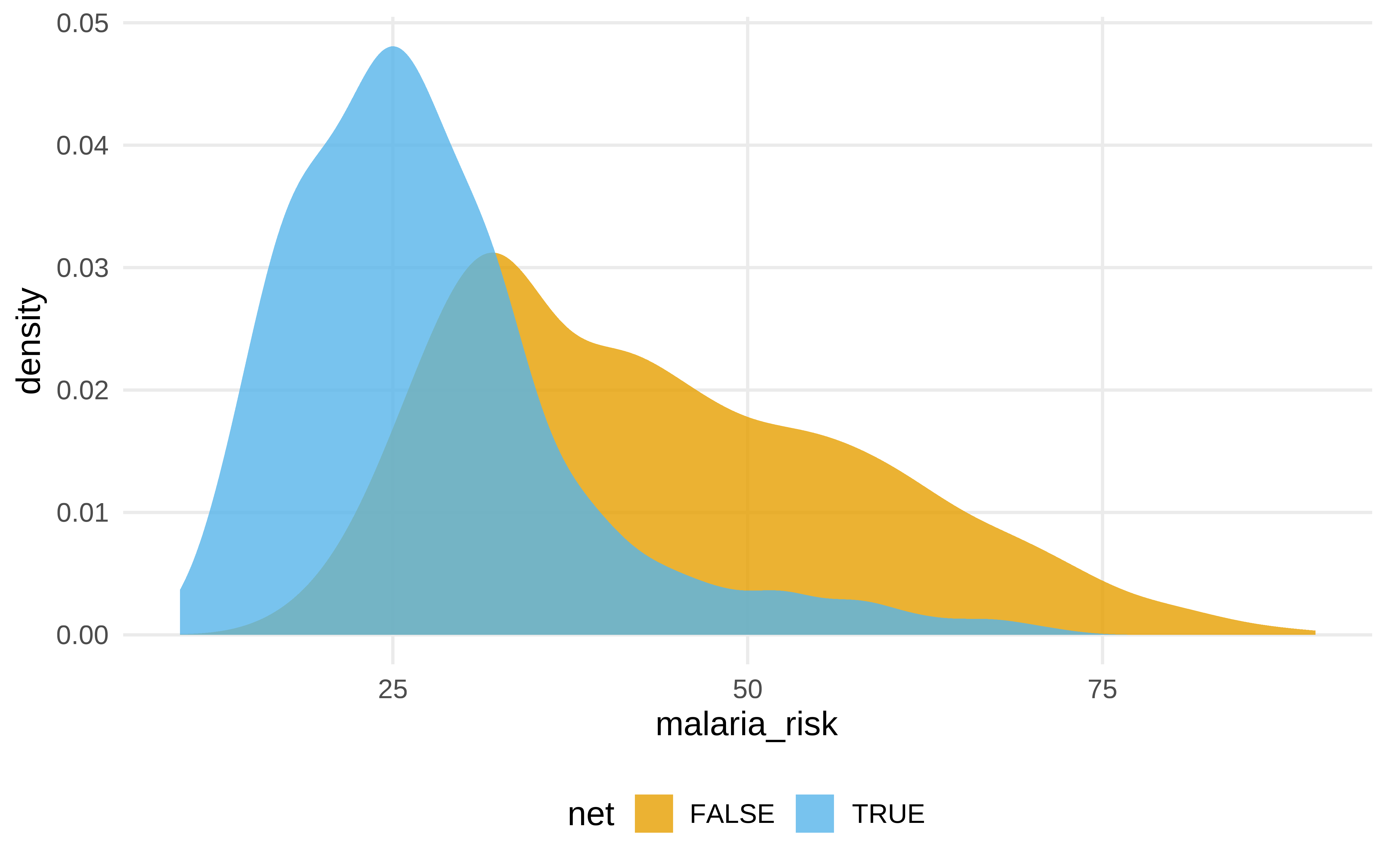
#> # A tibble: 2 × 2
#>   net   malaria_risk
#>   <lgl>        <dbl>
#> 1 FALSE         43.9
#> 2 TRUE          27.5
Show the code
#> # A tibble: 2 × 5
#>   term        estimate std.error statistic  p.value
#>   <chr>          <dbl>     <dbl>     <dbl>    <dbl>
#> 1 (Intercept)     43.9     0.377     116.  0
#> 2 netTRUE -16.4 0.741 -22.1 1.10e-95#> # A tibble: 2 × 5
#> term estimate std.error statistic p.value
#> <chr> <dbl> <dbl> <dbl> <dbl>
#> 1 netFALSE 43.9 0.377 116. 0
#> 2 netTRUE 27.5 0.638 43.1 1.26e-277Dibujar la asunciones
El uso de diagramas causales no es imprescindible, pero ayuda a explicitar las asunciones. Estas asunciones son nuestro modelo de como funcionar las relaciones entre las variables, pero puede que no sean correctas. Siempre habría que chequear el conocimiento experto y confrontar con otras explicaciones.
Show the code
library(tidyverse)
library(ggdag)
library(ggokabeito)
net_data <-  read_csv(here::here("data/net_data.csv"))
mosquito_dag <- dagify(
  malaria_risk ~ net + income + health + temperature + resistance,
  net ~ income + health + temperature + eligible + household,
  eligible ~ income + household,
  health ~ income,
  exposure = "net",
  outcome = "malaria_risk",
  coords = list(
    x = c(
      malaria_risk = 7,
      net = 3,
      income = 4,
      health = 5,
      temperature = 6,
      resistance = 8.5,
      eligible = 2,
      household = 1
    ),
    y = c(
      malaria_risk = 2,
      net = 2,
      income = 3,
      health = 1,
      temperature = 3,
      resistance = 2,
      eligible = 3,
      household = 2
    )
  ),
  labels = c(
    malaria_risk = "Risk of malaria",
    net = "Mosquito net",
    income = "Income",
    health = "Health",
    temperature = "Nighttime temperatures",
    resistance = "Insecticide resistance",
    eligible = "Eligible for program",
    household = "Number in the household"
  )
)

p1 <- mosquito_dag |>
  tidy_dagitty() |>
  node_status() |>
  ggplot(
    aes(x, y, xend = xend, yend = yend, color = status)
  ) +
  geom_dag_edges() +
  geom_dag_point() +
  geom_dag_label(color = "black") +
  # geom_dag_label_repel() +
  scale_color_okabe_ito(na.value = "grey90") +
  theme_dag() +
  theme(legend.position = "none") +
  coord_cartesian(clip = "off")
p1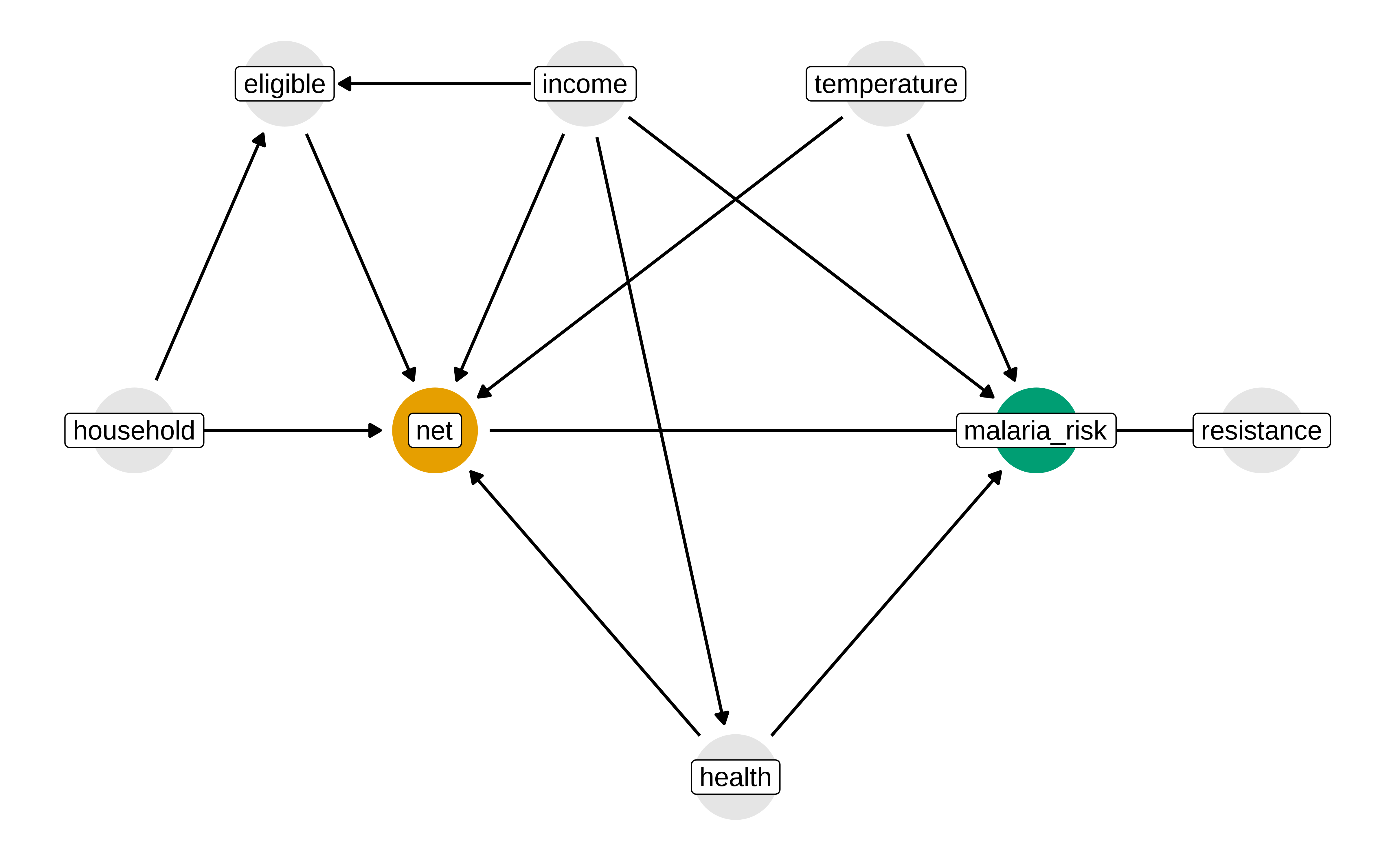
Modelar las asunciones
Dado el DAG anterior, vamos a utilizar una técnica conocida como propensity score weighting. El objetivo de esta técnica es crear una pseudopoblación que imite como habrían sido los datos si se hubiera hecho un RCT (Randomized Controlled Trial).
#>      1      2      3      4      5      6
#> 0.2464 0.2178 0.3230 0.2307 0.2789 0.3060Vemos los ipw. Si una observación ha caído en control pero tiene una probabilidad en el modelo de propensity score de 0.9, su peso es de 1 /(1-0.9) = 10 . Es decir, este individuo se considera un muy buen contrafactual para un individuo de iguales características que hubiera caido en tratamiento.
Show the code
#> # A tibble: 6 × 4
#>   net   net_num propensity_score   ipw
#>   <lgl>   <dbl>            <dbl> <dbl>
#> 1 FALSE       0            0.475  1.90
#> 2 FALSE       0            0.468  1.88
#> 3 FALSE       0            0.461  1.86
#> 4 FALSE       0            0.451  1.82
#> 5 FALSE       0            0.447  1.81
#> 6 FALSE       0            0.438  1.78
Show the code
#> # A tibble: 6 × 4
#>   net   net_num propensity_score   ipw
#>   <lgl>   <dbl>            <dbl> <dbl>
#> 1 TRUE        1            0.117  8.56
#> 2 TRUE        1            0.120  8.33
#> 3 TRUE        1            0.126  7.92
#> 4 TRUE        1            0.136  7.36
#> 5 TRUE        1            0.138  7.27
#> 6 TRUE        1            0.139  7.19
Diagnosticar las asunciones
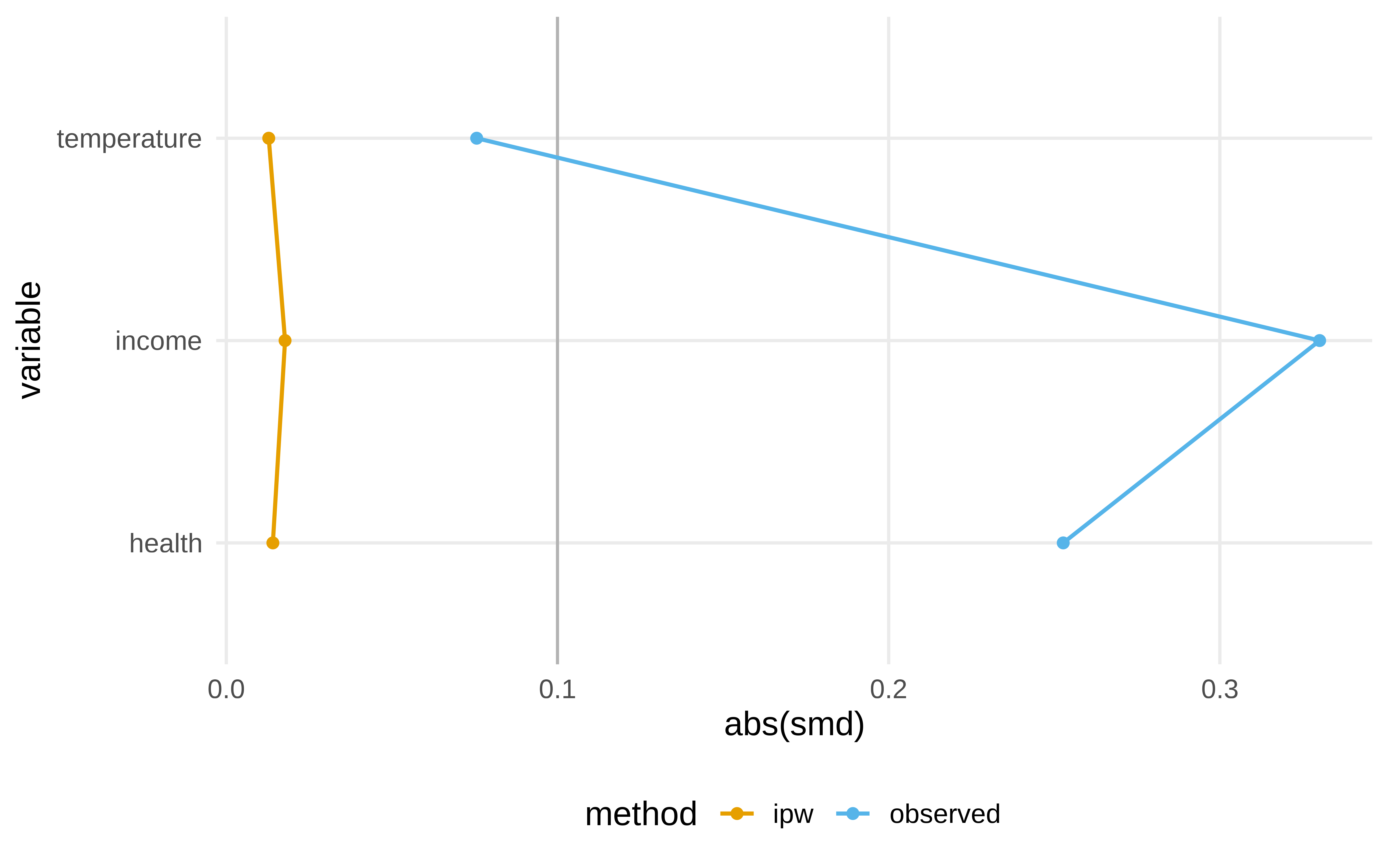
¿Qué es lo que ha cambiado al hacer el ipw?
Show the code
library(halfmoon)

net_data_with_ipw |>
  ggplot( aes(propensity_score)) +
  geom_mirror_histogram(
    aes(fill = net),
    bins = 50
  ) +
  scale_y_continuous(labels = abs) +
  labs(x = "propensity score")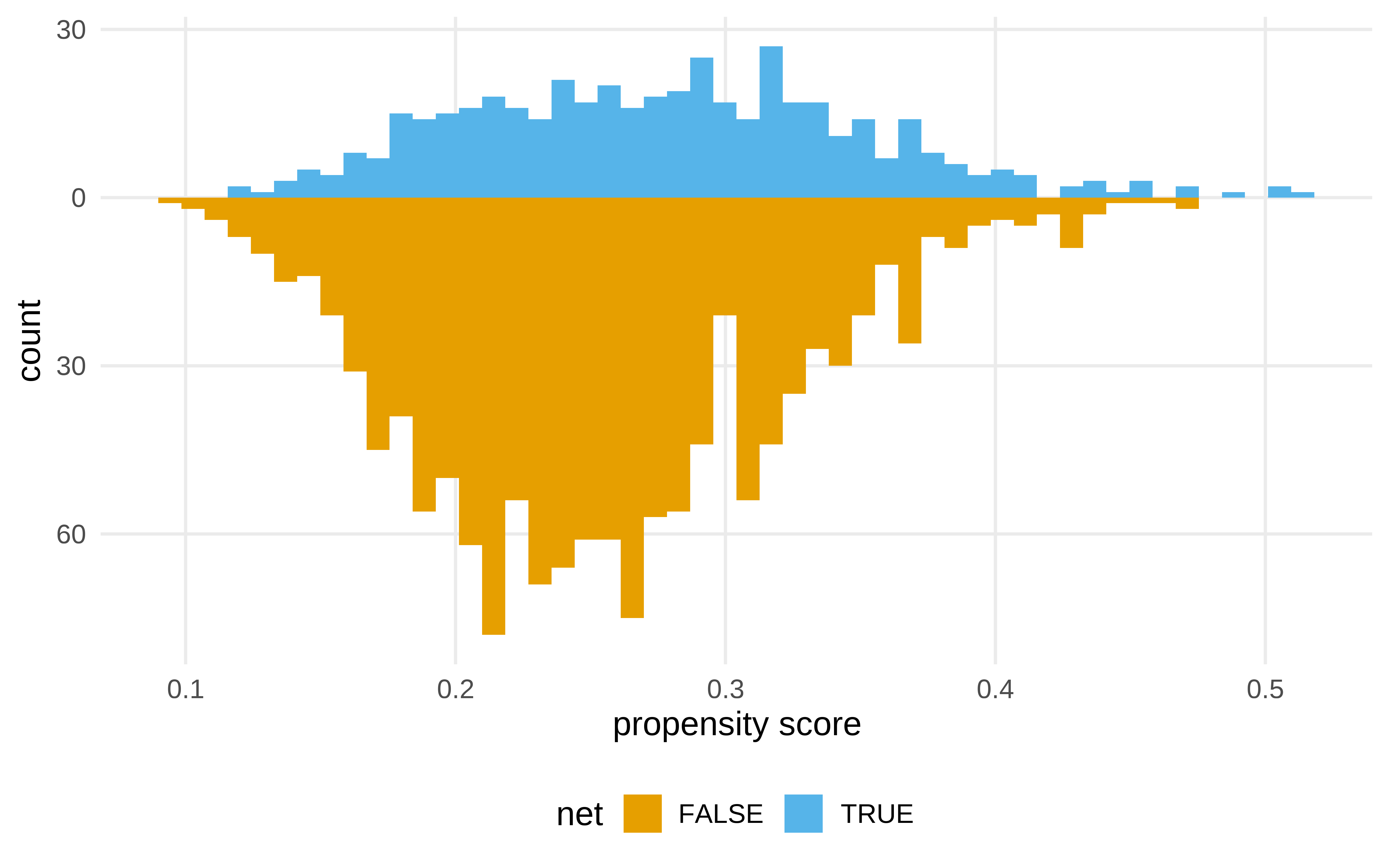
Estimar el efecto causal
Usando ipw
Show the code
#> # A tibble: 1 × 7
#>   term   estimate std.error statistic  p.value conf.low
#>   <chr>     <dbl>     <dbl>     <dbl>    <dbl>    <dbl>
#> 1 netTR…    -12.5     0.624     -20.1 5.50e-81    -13.8
#> # ℹ 1 more variable: conf.high <dbl>
Pero una vez se ha hecho el ipw, la varianza del estimador que da el modelo lm no es correcta, hay que calcularla usando otras técnicas, como estimadores robustos o bootstrap. Usaremos bootstrap
Show the code
library(rsample)

# todo el proceso
fit_ipw <- function(split, ...) {
  # get bootstrapped data sample with `rsample::analysis()`
  .df <- analysis(split)

  # fit propensity score model
  propensity_model <- glm(
    net ~ income + health + temperature,
    data = .df,
    family = binomial()
  )

  # calculate inverse probability weights
  .df <-  .df |>
  mutate(
    propensity_score = predict(propensity_model, type = "response")
  ) |>
  mutate(
    ipw = ifelse(net_num == 1, 1 / propensity_score, 1 / (1 - propensity_score))
  )


  # fit correctly bootstrapped ipw model
  lm(malaria_risk ~ net, data = .df, weights = ipw) |>
    tidy()
}
Show the code
bootstrapped_net_data <- bootstraps(
  net_data,
  times = 1000,
  # required to calculate CIs later
  apparent = TRUE
)

bootstrapped_net_data
#> # Bootstrap sampling with apparent sample
#> # A tibble: 1,001 × 2
#> splits id
#> <list> <chr>
#> 1 <split [1752/633]> Bootstrap0001
#> 2 <split [1752/633]> Bootstrap0002
#> 3 <split [1752/639]> Bootstrap0003
#> 4 <split [1752/640]> Bootstrap0004
#> 5 <split [1752/648]> Bootstrap0005
#> 6 <split [1752/641]> Bootstrap0006
#> 7 <split [1752/669]> Bootstrap0007
#> 8 <split [1752/647]> Bootstrap0008
#> 9 <split [1752/619]> Bootstrap0009
#> 10 <split [1752/661]> Bootstrap0010
#> # ℹ 991 more rowsShow the code
#> # Bootstrap sampling with apparent sample
#> # A tibble: 1,001 × 3
#>    splits             id            boot_fits
#>    <list>             <chr>         <list>
#>  1 <split [1752/633]> Bootstrap0001 <tibble [2 × 5]>
#>  2 <split [1752/633]> Bootstrap0002 <tibble [2 × 5]>
#>  3 <split [1752/639]> Bootstrap0003 <tibble [2 × 5]>
#>  4 <split [1752/640]> Bootstrap0004 <tibble [2 × 5]>
#>  5 <split [1752/648]> Bootstrap0005 <tibble [2 × 5]>
#>  6 <split [1752/641]> Bootstrap0006 <tibble [2 × 5]>
#>  7 <split [1752/669]> Bootstrap0007 <tibble [2 × 5]>
#>  8 <split [1752/647]> Bootstrap0008 <tibble [2 × 5]>
#>  9 <split [1752/619]> Bootstrap0009 <tibble [2 × 5]>
#> 10 <split [1752/661]> Bootstrap0010 <tibble [2 × 5]>
#> # ℹ 991 more rows
Show the code
ipw_results$boot_fits[[1]]#> # A tibble: 2 × 5
#> term estimate std.error statistic p.value
#> <chr> <dbl> <dbl> <dbl> <dbl>
#> 1 (Intercept) 42.9 0.445 96.4 0
#> 2 netTRUE -13.0 0.630 -20.6 1.03e-84Show the code
# pintamos los resultadosShow the code
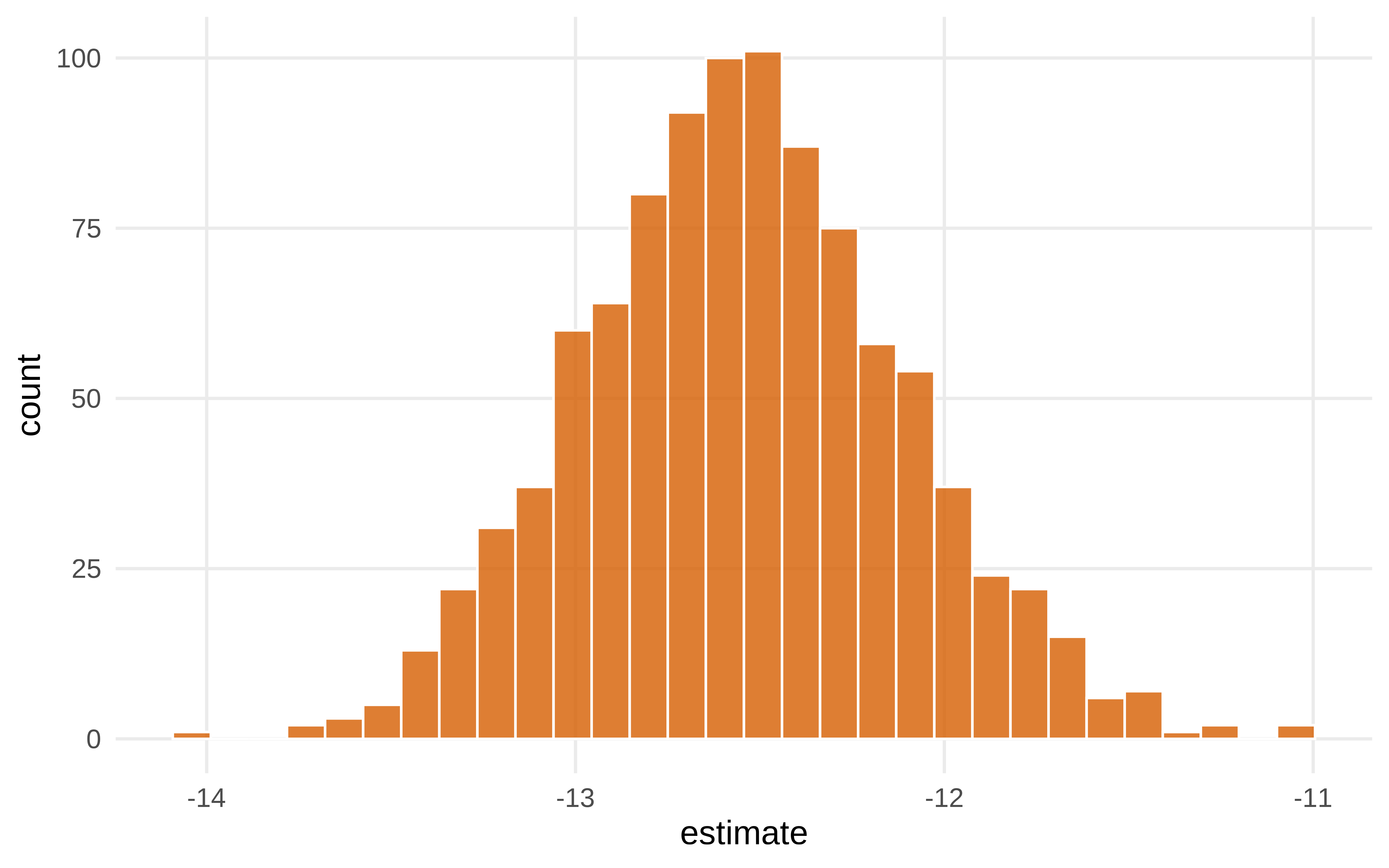
Show the code
#> # A tibble: 1 × 6
#>   term    .lower .estimate .upper .alpha .method
#>   <chr>    <dbl>     <dbl>  <dbl>  <dbl> <chr>
#> 1 netTRUE  -13.6     -12.5  -11.4   0.01 percentile
Usando reglas de Pearl
Pensemos como cortar los caminos no causales
Show the code
p1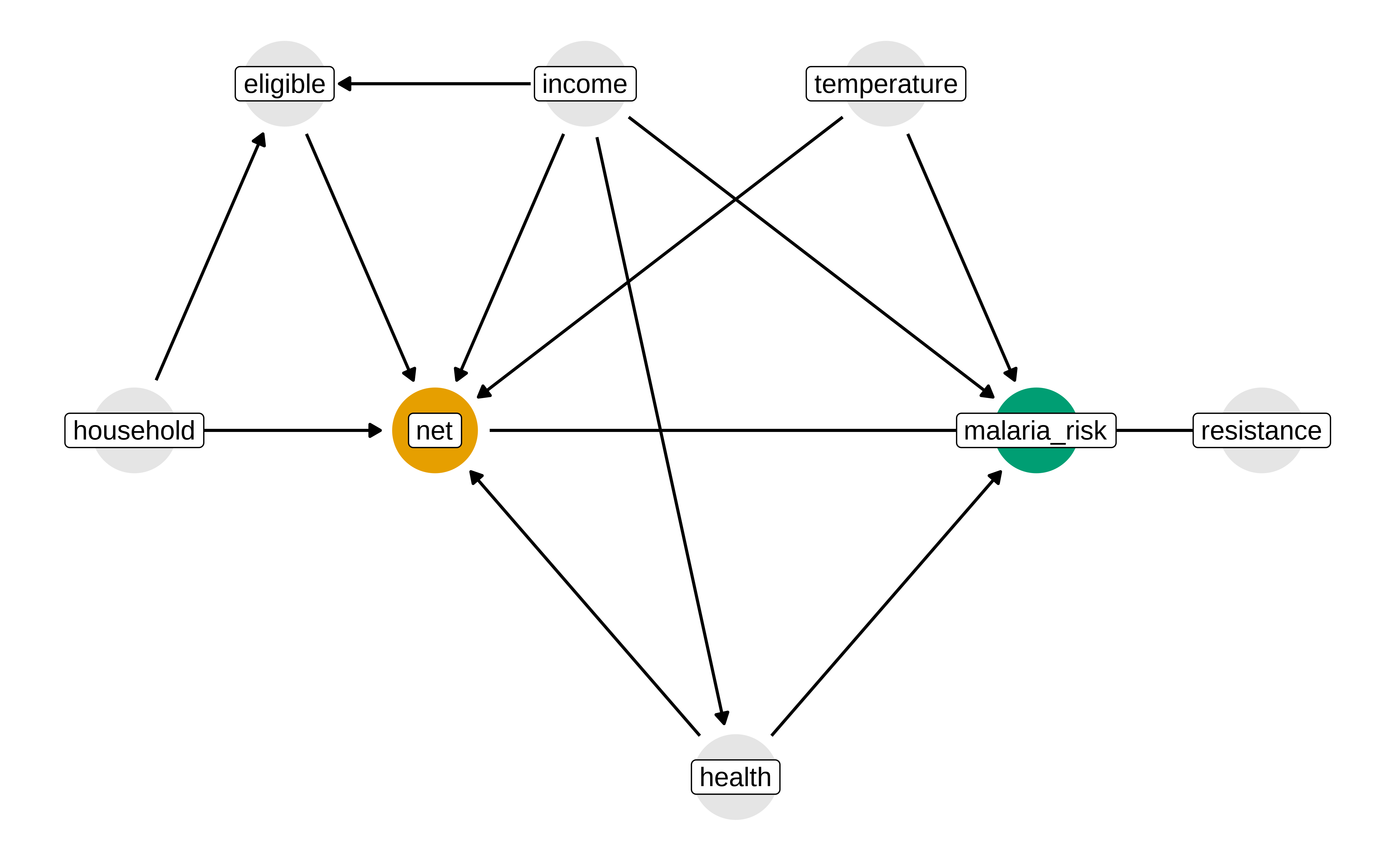
Pero la librería dagitty nos sirve para esto
Show the code
dagitty::adjustmentSets(mosquito_dag, effect = "total")#> { health, income, temperature }Show the code
ggdag_adjustment_set(mosquito_dag, effect = "total")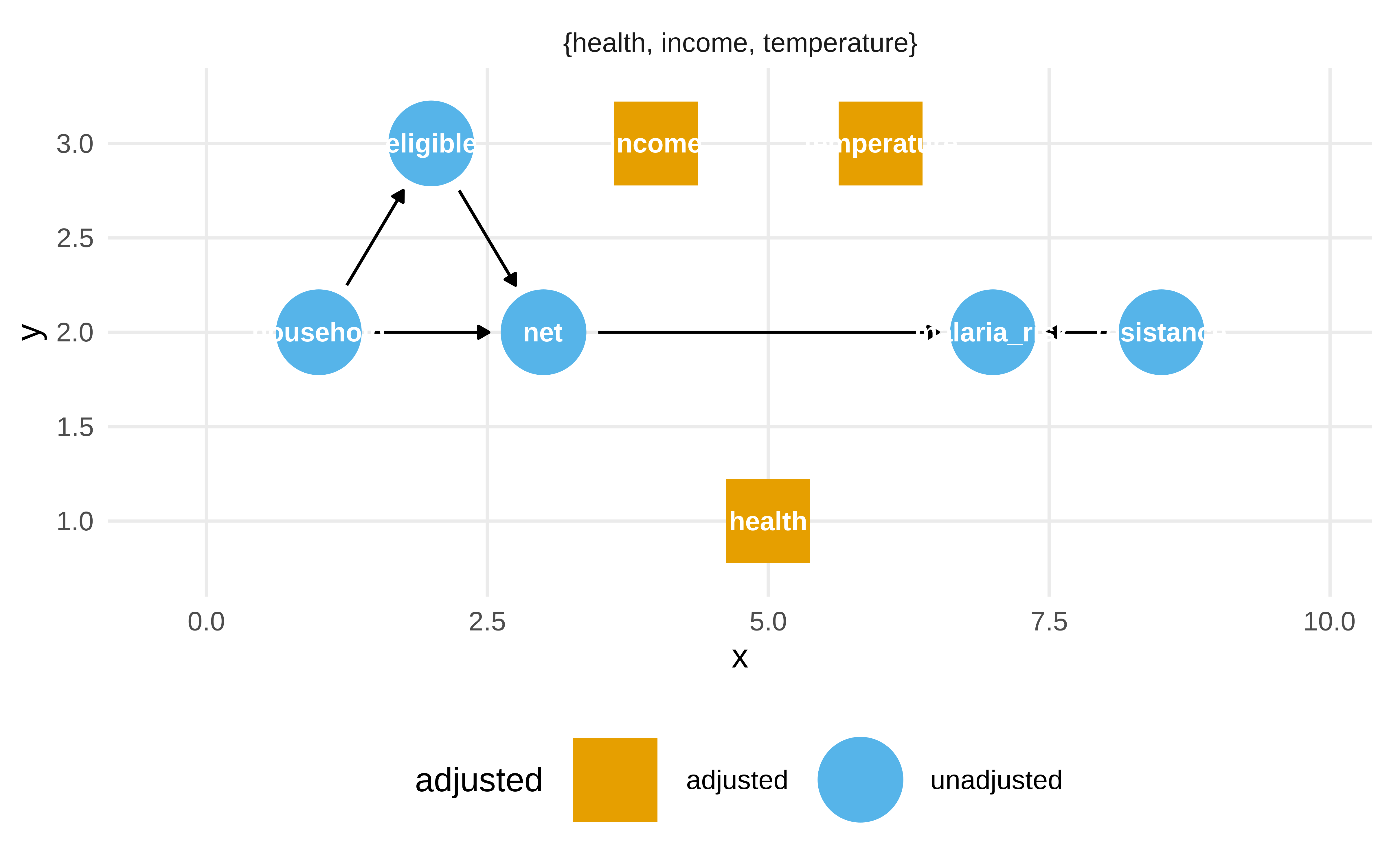
Show the code
#> # A tibble: 1 × 7
#>   term  estimate std.error statistic   p.value conf.low
#>   <chr>    <dbl>     <dbl>     <dbl>     <dbl>    <dbl>
#> 1 netT…    -12.0     0.314     -38.2 2.69e-232    -12.6
#> # ℹ 1 more variable: conf.high <dbl>Show the code
net_data |>
  ggplot(aes(income, fill = net)) +
  geom_density(color = NA, alpha = .8)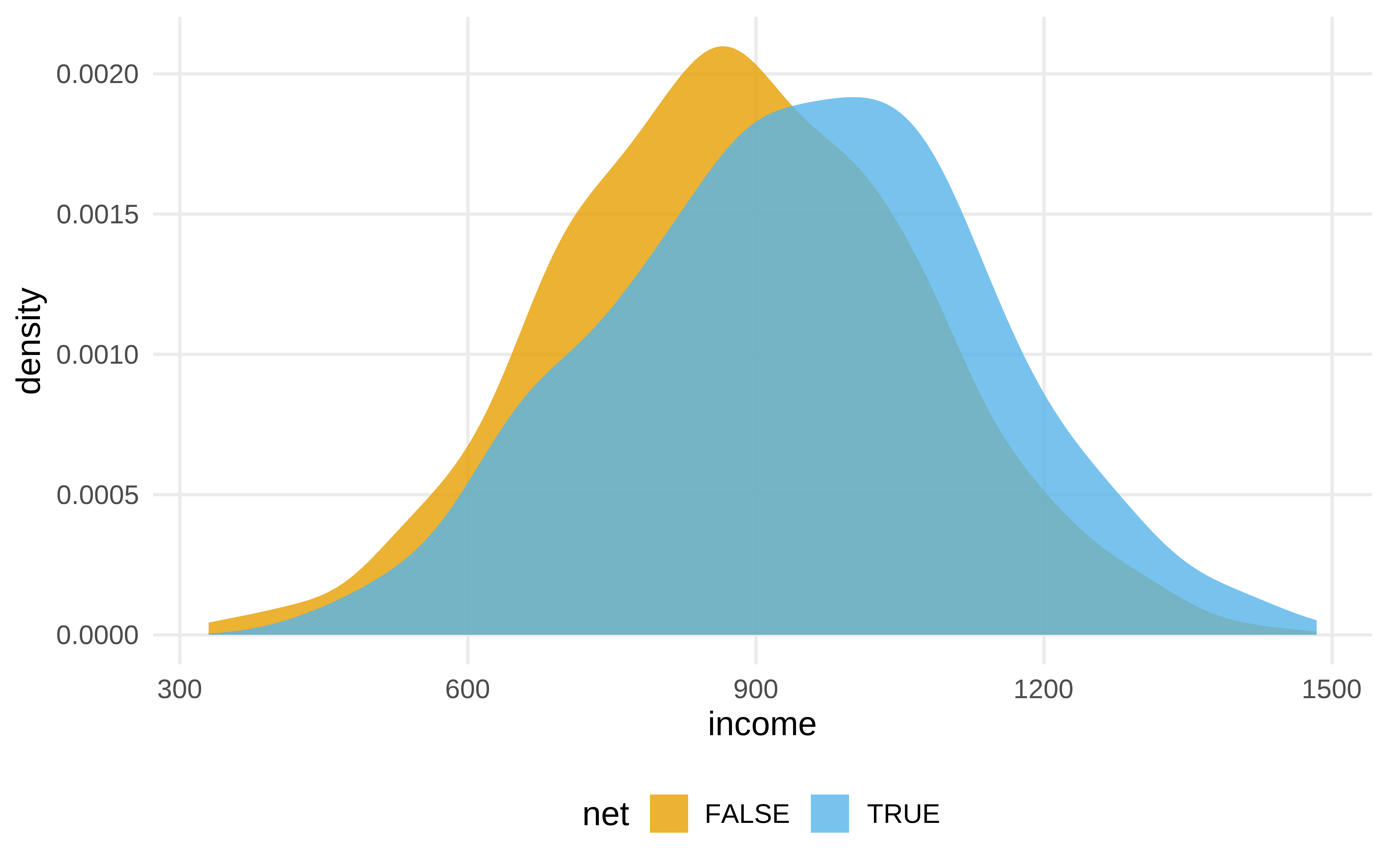
Show the code
net_data |>
  ggplot(aes(temperature, fill = net)) +
  geom_density(color = NA, alpha = .8)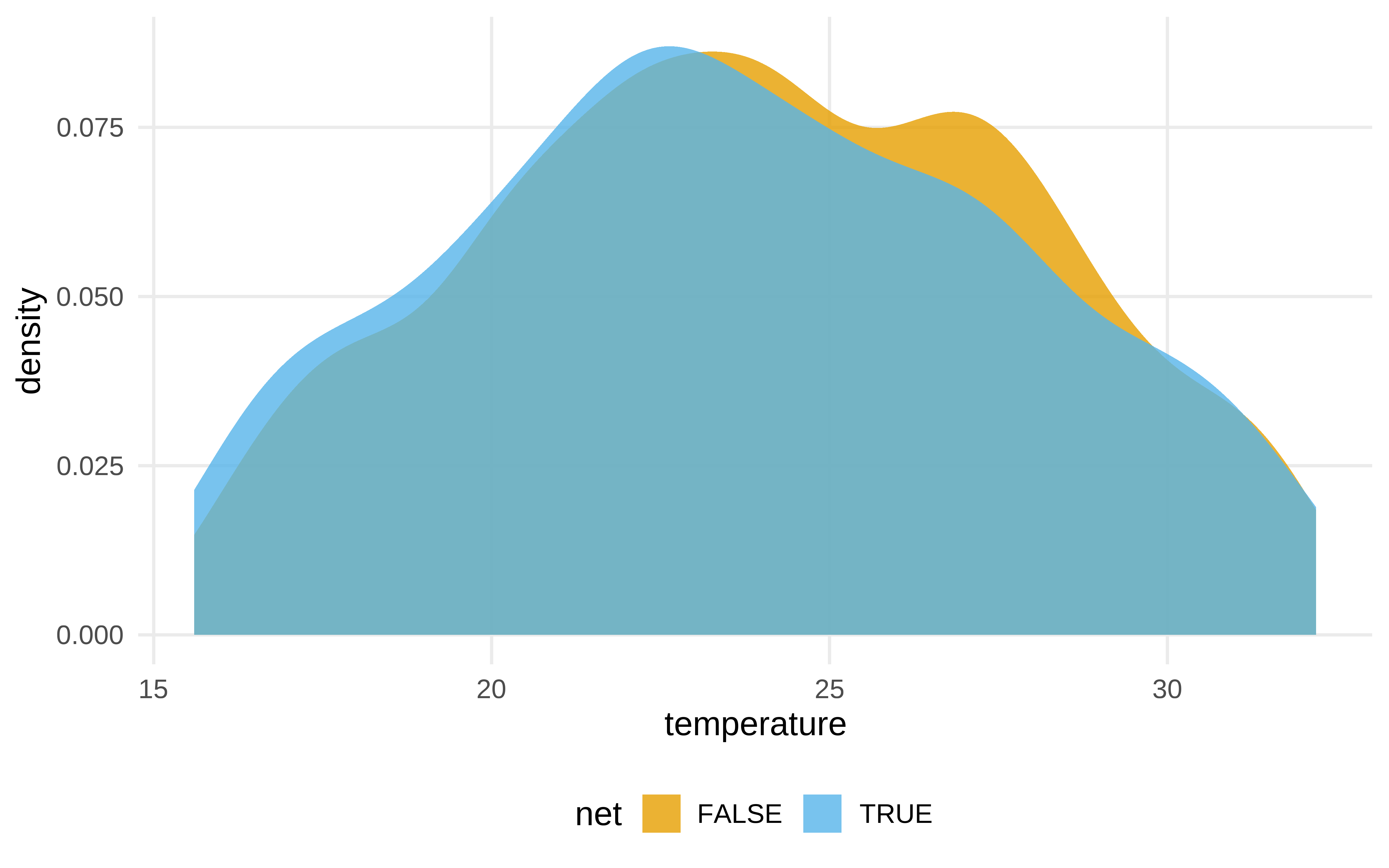
Show the code
net_data |>
  ggplot(aes(health , fill = net)) +
  geom_density(color = NA, alpha = .8)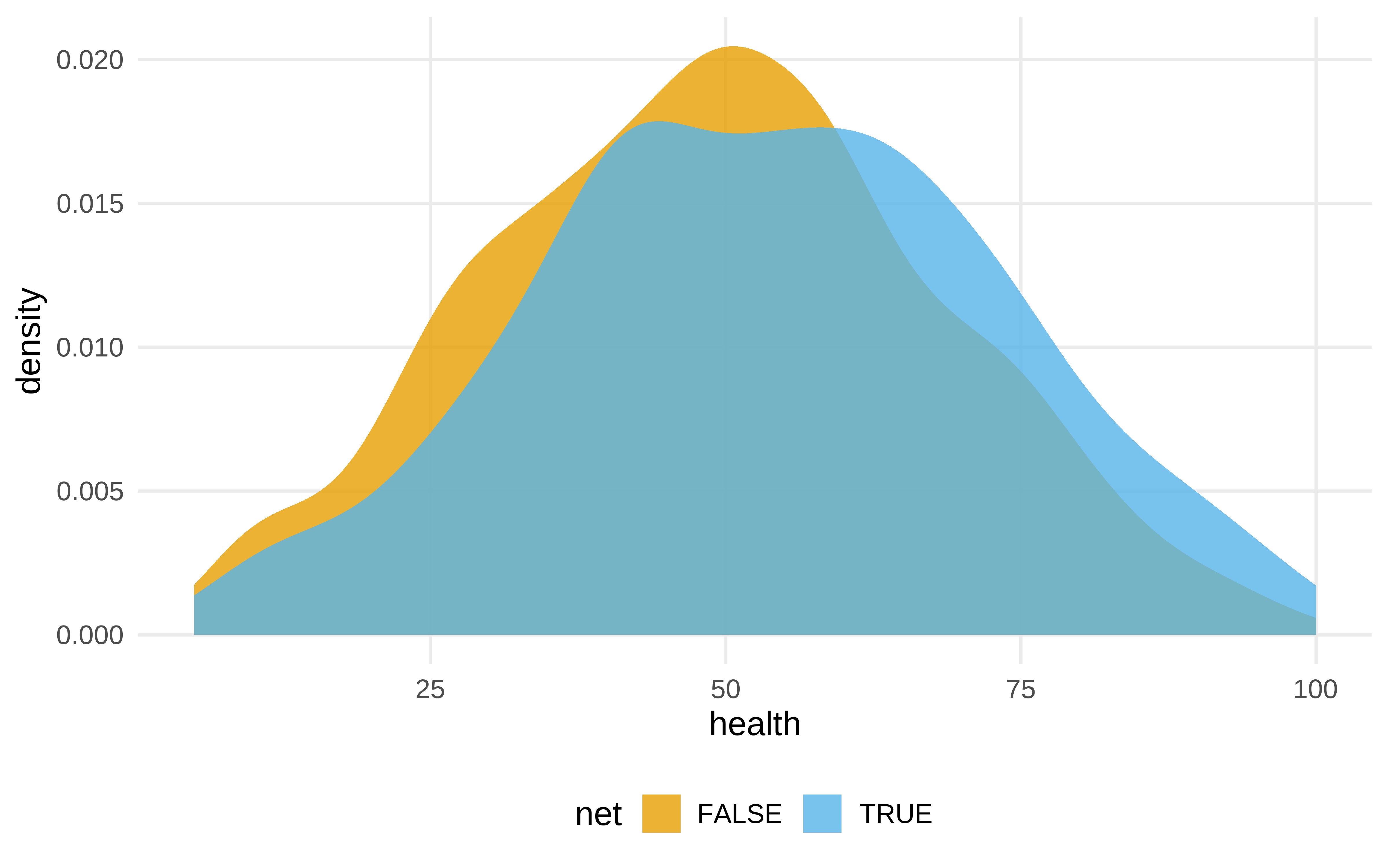
Modelo bayesiano
Show the code
m_bayesian <- brm(
  malaria_risk ~ net + income + temperature + health ,
  data = net_data,
  seed = 48,
  chains = 4,
  iter = 4000,
  warmup = 1000,
  cores = 4,
  file = here::here("brms_stan_models/net_1"),
  file_refit = "on_change"

)

# hqy que evitar el exceso de decimales dando impresión de falsa exactitud
m_bayesian
#> Family: gaussian
#> Links: mu = identity; sigma = identity
#> Formula: malaria_risk ~ net + income + temperature + health
#> Data: net_data (Number of observations: 1752)
#> Draws: 4 chains, each with iter = 4000; warmup = 1000; thin = 1;
#> total post-warmup draws = 12000
#>
#> Regression Coefficients:
#> Estimate Est.Error l-95% CI u-95% CI Rhat
#> Intercept 79.36 1.03 77.35 81.39 1.00
#> netTRUE -12.00 0.31 -12.61 -11.39 1.00
#> income -0.08 0.00 -0.08 -0.07 1.00
#> temperature 1.01 0.03 0.94 1.08 1.00
#> health 0.14 0.01 0.12 0.16 1.00
#> Bulk_ESS Tail_ESS
#> Intercept 11125 10282
#> netTRUE 10925 8382
#> income 11593 9652
#> temperature 10913 8132
#> health 11001 9015
#>
#> Further Distributional Parameters:
#> Estimate Est.Error l-95% CI u-95% CI Rhat
#> sigma 5.70 0.10 5.51 5.89 1.00
#> Bulk_ESS Tail_ESS
#> sigma 12498 8777
#>
#> Draws were sampled using sample(hmc). For each parameter, Bulk_ESS
#> and Tail_ESS are effective sample size measures, and Rhat is the potential
#> scale reduction factor on split chains (at convergence, Rhat = 1).Show the code
round(posterior_summary(m_bayesian, variable = "b_netTRUE"), 2)#> Estimate Est.Error Q2.5 Q97.5
#> b_netTRUE -12 0.31 -12.61 -11.39Show the code
m_bayesian |>
  as_tibble() |>
  ggplot() +
  ggdist::stat_halfeye(
    aes( x = b_netTRUE),
    fill = "darkred",
    alpha = 0.4)  +
  ggdist::theme_ggdist()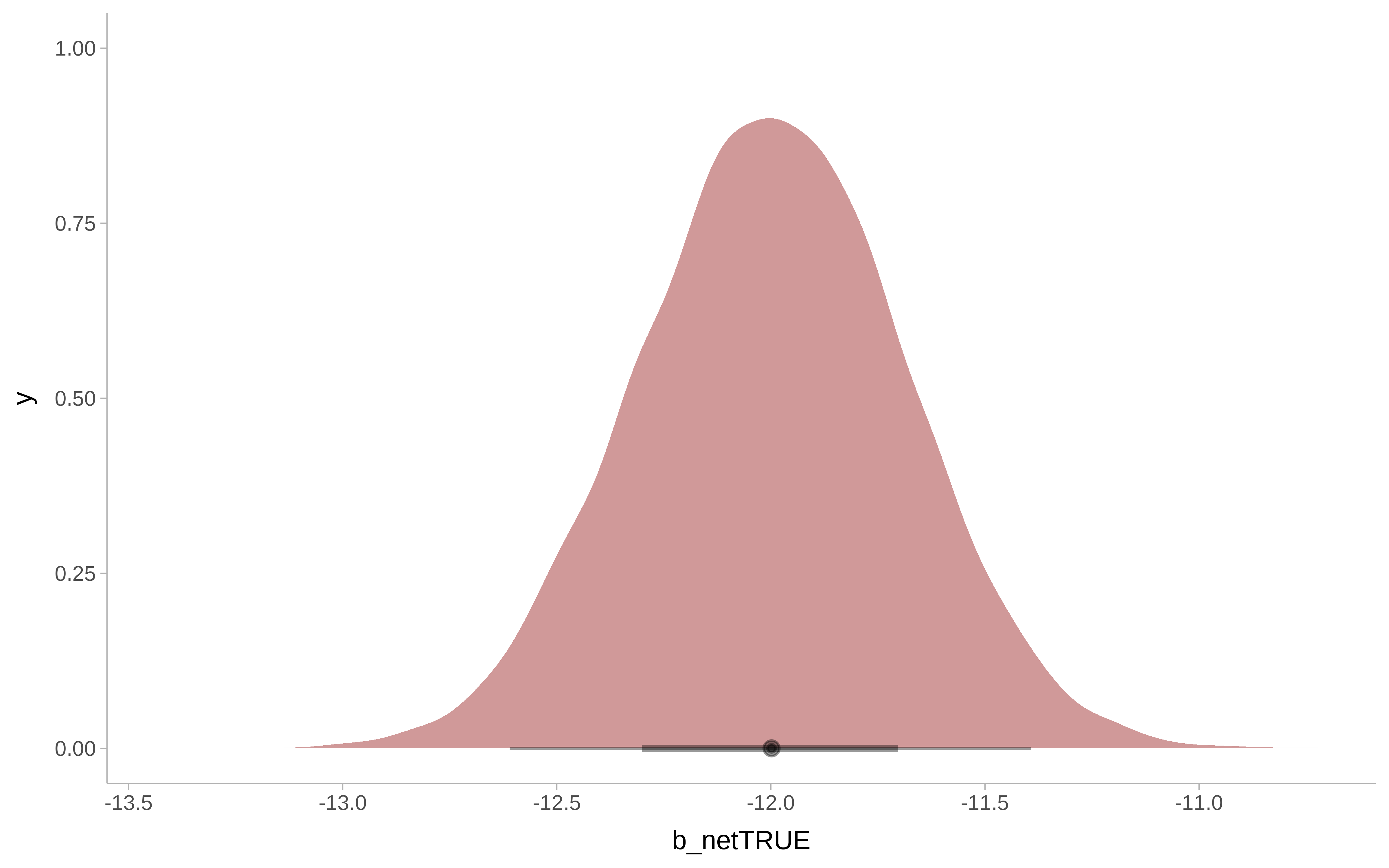
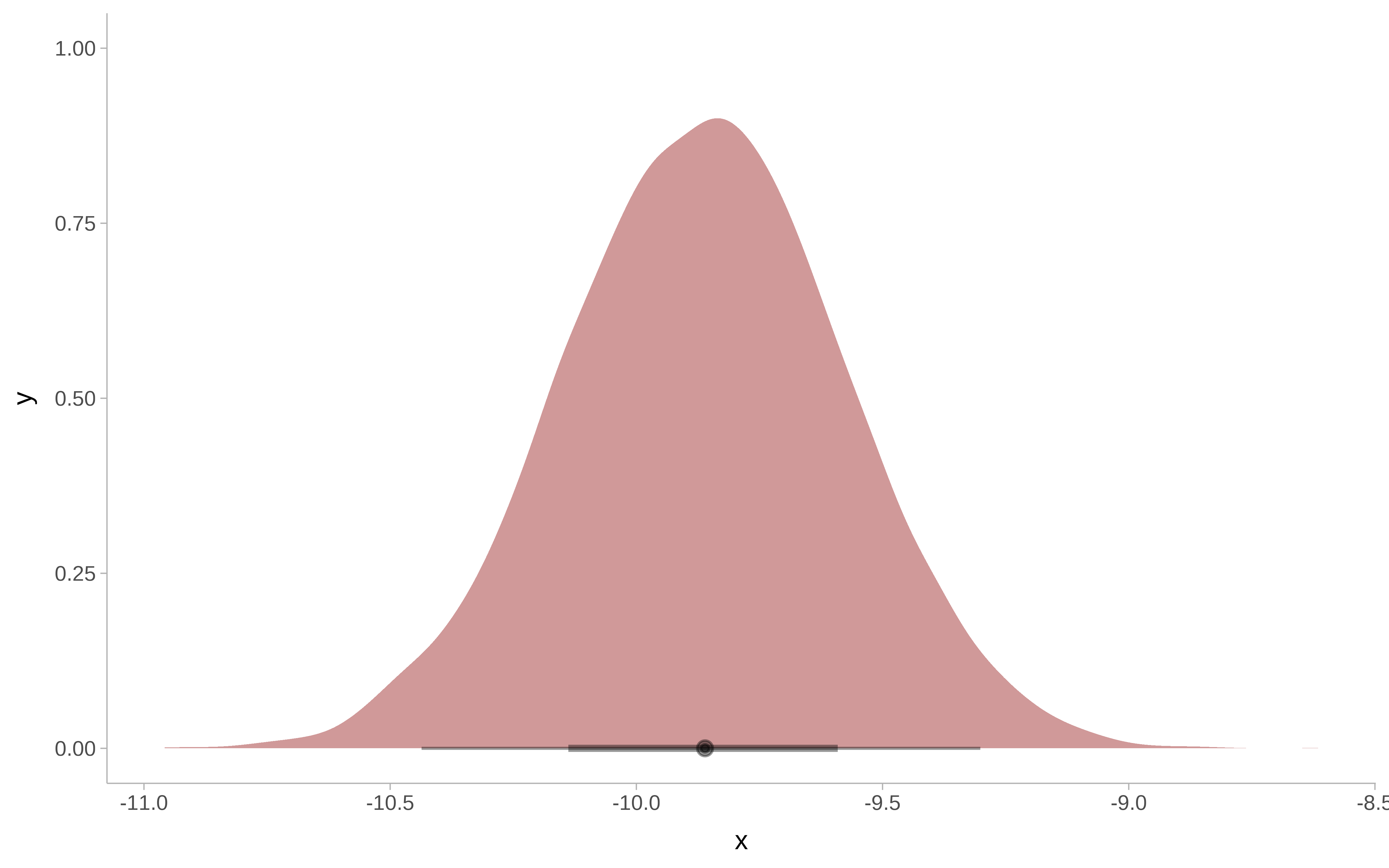
Análisis de sensibilidad
Y si hubiera una variable de confusión no observada?. Si fuera un RCT, el mismo mecanismo de aleatorización nos protege frente a esas variables, pero no en un estudio observacional.
Imaginemos que existe una variable de confusión que es resistencia genética de la población a la malaria.
Suponemos lo siguiente.
- Está asociada con la variable respuesta, porque en media la gente con resistencia genética tiene una reducción de riesgo alrededor de 10.
- Está asociada con la variable de tratamiento, puesto que entre los que usan mosquiteras, el 26 % tienen esta resistencia. Pero entre los que no usan mosquiteras, solo el 5% la tienen.
Con la librería tipr se puede inferir cuál sería el efecto si existiera ese confounder no observado.
Verdadero DAG
Y después de todo, como los datos son simulados sabemos que existe una variable de confusión
Show the code
mosquito_dag_full <- dagify(
  malaria_risk ~ net + income + health + temperature + insecticide_resistance + genetic_resistance,
  net ~ income + health + temperature + eligible + household + genetic_resistance,
  eligible ~ income + household,
  health ~ income,
  exposure = "net",
  outcome = "malaria_risk",
  coords = list(
    x = c(
      malaria_risk = 7,
      net = 3,
      income = 4,
      health = 5,
      temperature = 6,
      insecticide_resistance = 8.5,
      eligible = 2,
      household = 1,
      genetic_resistance = 8.5
    ),
    y = c(
      malaria_risk = 2,
      net = 2,
      income = 3,
      health = 1,
      temperature = 3,
      insecticide_resistance = 2,
      eligible = 3,
      household = 2,
      genetic_resistance = 1
    )
  ),
  labels = c(
    malaria_risk = "Risk of malaria",
    net = "Mosquito net",
    income = "Income",
    health = "Health",
    temperature = "Nighttime temperatures",
    insecticide_resistance = "Insecticide resistance",
    eligible = "Eligible for program",
    household = "Number in household",
    genetic_resistance = "Malaria resistance"
  )
)

mosquito_dag_full |>
  tidy_dagitty() |>
  node_status() |>
  ggplot(
    aes(x, y, xend = xend, yend = yend, color = status)
  ) +
  geom_dag_edges() +
  geom_dag_point() +
  geom_dag_label_repel() +
  scale_color_okabe_ito(na.value = "grey90") +
  theme_dag() +
  theme(legend.position = "none") +
  coord_cartesian(clip = "off")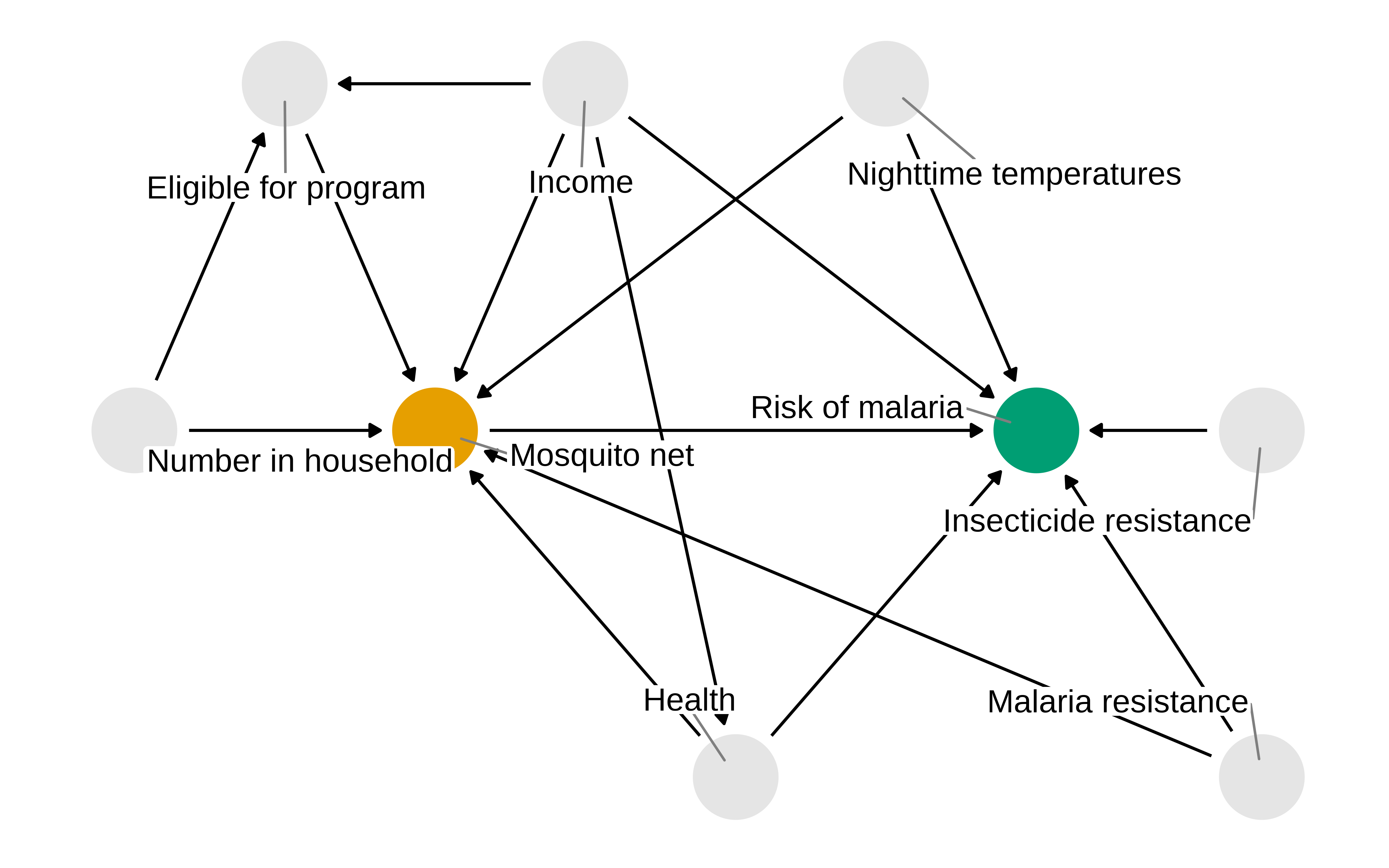
#> Rows: 1,752
#> Columns: 11
#> $ id                     <int> 1, 2, 3, 4, 5, 6, 7, 8…
#> $ net                    <lgl> FALSE, FALSE, FALSE, F…
#> $ net_num                <int> 0, 0, 0, 0, 0, 0, 0, 0…
#> $ malaria_risk           <int> 38, 48, 32, 55, 36, 30…
#> $ income                 <int> 779, 700, 1083, 753, 9…
#> $ health                 <int> 35, 35, 58, 68, 46, 37…
#> $ household              <int> 1, 3, 3, 3, 5, 3, 1, 2…
#> $ eligible               <lgl> FALSE, FALSE, FALSE, F…
#> $ temperature            <dbl> 18.3, 18.6, 24.2, 19.1…
#> $ insecticide_resistance <int> 38, 40, 70, 57, 59, 49…
#> $ genetic_resistance     <int> 0, 0, 0, 0, 0, 0, 0, 1…
Show the code
fit_ipw_full <- function(split, ...) {
  # get bootstrapped data sample with `rsample::analysis()`
  .df <- analysis(split)

  # fit propensity score model
  propensity_model <- glm(
    net ~ income + health + temperature + genetic_resistance,,
    data = .df,
    family = binomial()
  )

  # calculate inverse probability weights
  .df <-  .df |>
  mutate(
    propensity_score = predict(propensity_model, type = "response")
  ) |>
  mutate(
    ipw = ifelse(net_num == 1, 1 / propensity_score, 1 / (1 - propensity_score))
  )


  # fit correctly bootstrapped ipw model
  lm(malaria_risk ~ net, data = .df, weights = ipw) |>
    tidy()
}
Show the code
bootstrapped_net_data_full <- bootstraps(
  net_data_full,
  times = 1000,
  # required to calculate CIs later
  apparent = TRUE
)

ipw_results_full <- bootstrapped_net_data_full |>
  mutate(boot_fits = map(splits, fit_ipw_full))

boot_estimate_full <- ipw_results_full |>
  # calculate T-statistic-based CIs
  int_t(boot_fits) |>
  filter(term == "netTRUE")

boot_estimate_full
#> # A tibble: 1 × 6
#> term .lower .estimate .upper .alpha .method
#> <chr> <dbl> <dbl> <dbl> <dbl> <chr>
#> 1 netTRUE -11.3 -10.2 -9.34 0.05 student-tShow the code
#>  Family: gaussian
#>   Links: mu = identity; sigma = identity
#> Formula: malaria_risk ~ net + income + temperature + health + genetic_resistance
#>    Data: net_data_full (Number of observations: 1752)
#>   Draws: 4 chains, each with iter = 4000; warmup = 1000; thin = 1;
#>          total post-warmup draws = 12000
#>
#> Regression Coefficients:
#>                    Estimate Est.Error l-95% CI
#> Intercept             79.29      0.90    77.52
#> netTRUE               -9.86      0.29   -10.44
#> income                -0.08      0.00    -0.08
#> temperature            1.04      0.03     0.98
#> health                 0.14      0.01     0.12
#> genetic_resistance    -9.52      0.41   -10.31
#>                    u-95% CI Rhat Bulk_ESS Tail_ESS
#> Intercept             81.03 1.00    10903     9660
#> netTRUE               -9.30 1.00    10819     8422
#> income                -0.07 1.00    11791     9128
#> temperature            1.10 1.00    10462     8164
#> health                 0.16 1.00    11451     8186
#> genetic_resistance    -8.71 1.00     9734     8175
#>
#> Further Distributional Parameters:
#>       Estimate Est.Error l-95% CI u-95% CI Rhat
#> sigma     4.99      0.08     4.83     5.16 1.00
#>       Bulk_ESS Tail_ESS
#> sigma    11168     8306
#>
#> Draws were sampled using sample(hmc). For each parameter, Bulk_ESS
#> and Tail_ESS are effective sample size measures, and Rhat is the potential
#> scale reduction factor on split chains (at convergence, Rhat = 1).
Show the code
round(posterior_summary(m_bayesian_full, variable = "b_netTRUE"), 2)#> Estimate Est.Error Q2.5 Q97.5
#> b_netTRUE -9.86 0.29 -10.44 -9.3Show the code
posteriores <-  as_tibble(m_bayesian_full)

post_rvars <- as_draws_rvars(posteriores)

post_rvars$b_netTRUE |>
  enframe() |>
  ggplot() +
  ggdist::stat_halfeye(
    aes( xdist = value),
    fill = "darkred",
    alpha = 0.4)  +
  ggdist::theme_ggdist()